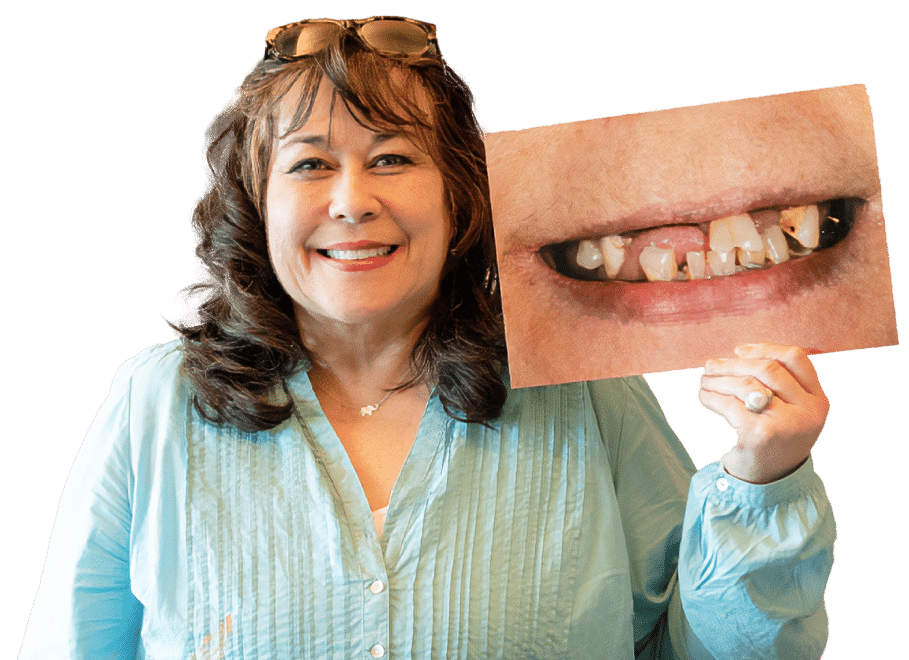
While Dr Timmerman is a Seattle Cosmetic Dentist, he also performs general dentistry as well. Often people remark that they thought he only did smiles, but the fact is even regular cleanings and fillings are done here as well. If you would like full service dental care for your whole family, call 206-241-5533!

We haven’t really shared much about this product, but there is quite a bit of interest. If you haven’t heard, there is a product available now that allows a person to improve their smile with a device that literally snaps in place. Snap-on-Smile!

Some have reported that they CAN eat with it in, but many choose not to. Since it doesn’t bond in place, it cannot be considered a permanent solution, but it DOES allow a person to try out a new smile before investing in a more permanent method. It is made out of “plastic” and not porcelain like most smile makeovers are. As time goes on, one should expect the device to wear out, but in the meantime, you know what you can expect from a makeover.

If you would like to know more, or for a free consultation, call us at 206-241-5533.

We often have people want a smile makeover in the most conservative fashion. Dr Timmerman is a Seattle Cosmetic Dentist that does Extreme Tooth Whitening here in Seattle. Also called Deep Bleaching, we have found this to be the most effective way to whiten teeth. More information is on the main page of this website or our “sister” website at www.BestSeattleDentist.com.

Give us a call at 206-241-5533 to learn more or schedule your free consultation!

Somehow, I have been convinced that I should ride my bike a long distance again. What was I thinking?

I will participate in the RAMROD this year, the Ride Around Mount Rainier in One Day. 150 miles, 10,000 feet of elevation. July 31st.

I feel tired just thinking about it…

I came across this information recently and thought it would be nice to share. I don’t have any affiliation to this company and make no money from this, but thought others may benefit.

__________________________________________________________

I am Dr. John Bruinsma, a dentist, and my wife Debra is a dental hygienist. In 1995, we founded Dr. John’s Candies® and are committed to offering the best tasting sugar free candy available to you.

We introduced Dr. John’s Candies® at the American Dental Association Annual Meeting that same year, and soon became the best selling sugar free candy offered to dentists in the United States.

For over twenty five years, our confectioner has continued a family tradition of making “gourmet” sugar free candies. Together, we create blends that you will not find anywhere else, using only the finest flavorings and ingredients.

Recently, Dr. John’s Candies® has introduced new and enhanced flavors, swirls, shapes, customized candy wrappers, and packaging. Also, our orange flavored “Herbal Lollipop” is a very exciting breakthrough in the field of dentistry. UCLA dental researchers have isolated an herb from the Chinese licorice root that we add to our sugar free candy formula, which has scientifically demonstrated effectiveness to disable the primary bacteria that causes decay. Learn more about our cavity-fighting Herbal Lollipop.

Whether you are a diabetic, an individual shopping for healthier treats for you and your family, a dental or medical professional, or a business desiring to portray a healthy image, Dr. John’s Candies® will fulfill your need.

Our customers are very loyal and most of them have heard about us through “word of mouth.” They continually comment, “You can’t even tell it’s sugar free!” I guess that says it all.

Since you will probably not find Dr. John’s Candies® in your neighborhood supermarket or pharmacy, we are working to make it convenient and affordable for you to order directly through catalogs and online.

Try Dr. John’s Candies for yourself and see why we say…

“Get the Taste of a Healthier Lifestyle”™
Contact Dr. John’s Candies at (616) 454-3707 or info@drjohns.com

March 6, 2008
Skin Deep
My Root Canal? It’s a Blur
By SARAH KERSHAW
A MAN in a mask is wielding a drill that is so loud it makes you feel as if a bulldozer is plowing through your head.

A tube inside your cheek is vacuuming saliva. Water is sprayed across your teeth, and you are alternately gagging and having the strong sensation of drowning. The man is coming closer to your face with a needle that looks a lot like a sword from where you sit and, when inserted into your tender gums, will leave half your face paralyzed for hours.

What if you could forget you ever went to the dentist? What if the mask, the drill and the needle were mere blips in an incoherent dream and you could erase those images from your consciousness, something like an eternal sunshine of the spotless mouth?

And what if you were a dentist and could charge several hundred dollars for the promise of this glorious amnesia, tapping into a vast market of untreated patients hiding for years — their cavities unfilled, their crowns in disrepair, their gums a mess.

Enter relaxation dentistry, an appealing concept for the large number of people who dread and avoid the dentist. It is a fast-growing, hotly debated niche in the dental world that involves sedating adult patients with antianxiety drugs and sleeping pills for everything from routine cleanings and fillings to multiple root canals.

In the last five years, thousands of dentists have been trained to administer drugs to anxious patients using medications that doctors say create a mild amnesia for patients who are awake, but not necessarily alert, and may forget the whole experience or have only vague recollections.

But the practice has drawn mounting criticism from doctors and dentists who say it poses a dangerous risk of patients being oversedated by dentists who often have completed only a 24-hour training course and are not equipped to safely monitor the drugs.

Dentists and other medical professionals say the growth in relaxation dentistry is being driven by consumers’ increasing ease in using medications for everything from depression to erectile dysfunction and also by advances in sedation that mean patients can return to normal activities within a few hours of being medicated.

“Its been a big, big plus for millions of people who otherwise would have neglected their dental health, which in turn affects their overall health,” said Dr. Michael D. Silverman, a dentist who in 2000 founded the Dental Organization for Conscious Sedation, which offers 24-hour training courses, has more than 8,000 dentists as members and has spearheaded much of the marketing for oral sedation.

After warning that the rising use of oral sedation was not being adequately regulated, the American Dental Association published guidelines last year recommending that dentists undergo a minimum of 24 hours of training in sedating patients and 10 clinical experiences administering the medications, including three actual cases and one that involves bringing a patient back from deep sedation. The remaining cases can be simulated or watched on videotape.

Forty states, responding to reports of oversedation and other safety concerns, have either adopted those guidelines, developed their own that are more or less stringent, or are considering new regulations.

“There are absolute dental-phobes who stay away, even to the point of trying to take their teeth out with pliers,” said Dr. Joel M. Weaver, a spokesman for the dental association and an emeritus professor at the College of Dentistry at Ohio State University. “Now dentistry has a real way to treat them. But we want to be able to treat them safely.”

To bring the anxious patients out from their foxholes, a growing number of dentists have been marketing relaxation dentistry, or “oral conscious sedation” as it is also known, through television, newspaper and Internet advertisements, with enormous response.

Karen O’Hanley, 45, from Quincy, Mass., was so afraid of the dentist that she avoided the chair for four years, trying to scrape the plaque and stains off her teeth with tweezers.

“I was terrified, I was absolutely petrified,” said Ms. O’Hanley, describing anxiety-ridden visits to the dentist during which she sweated profusely. But last year, Ms. O’Hanley experienced relaxation dentistry, after hearing about it in a television advertisement. The procedure typically combines Valium and a sleeping pill sold under the brand name Halcyon.

She said she had no memory of getting three filings, a root canal, a bridge and a crown during one appointment.

The Valium is typically given the night before the appointment, while the sleeping pill is taken about an hour before the appointment. Adjustments are then made based on the patient’s response.

Dental appointments that involve oral sedation can take longer — on average about an hour, dentists say — because if the patient is not comfortable or adequately sedated, the dentist may administer more medication. But dentists who use the sedation say that patients could ultimately save time because they can get more work done in one appointment.

Now that Ms. O’Hanley has had one side of her mouth fixed last year, she said she would be willing to go back. She had no problem with the $400 her dentist charged for the sedation, on top of a $7,000 dental bill, only $1,500 of it covered by insurance.

“I don’t remember the needles, the gagging, the water,” she said “I certainly don’t remember being in the chair for five hours.”

Anesthesiologists say that the drugs used for sedation typically cause patients to lose some memory, even though they are conscious during the procedure. But memory loss is not guaranteed and it varies by patient depending on the dosages.

The side effects — drowsiness and fogginess — are considered moderate compared with the effects of undergoing general anesthesia, which is typically used for oral surgery and complicated procedures. But patients are told that they must be driven to and from the dental appointment if they are under sedation. The medications are also more potent in treating anxiety than nitrous oxide, or laughing gas, which is often used by dentists but is much shorter-acting, doctors say.

Many dentists can administer antianxiety drugs intravenously, a procedure that is often covered by insurance, dentists say, but that typically requires more training than oral sedation; the dental association guidelines recommend 60 hours of training and experience with 20 patient cases.

Some dentists say oral sedation is a dangerous trend that, if unchecked, could lead to serious risk for patients. The critics say that intravenous sedation is much more precise and therefore safer because pills take longer to absorb into the bloodstream, and dentists may keep giving more without knowing the full impact.

Dentists who practice oral sedation can use another medication, Flumazinil, which effectively reverses the sedative effects of the Valium and Halcyon in a relatively short period, doctors say, if they find a patient is oversedated.

Still, oral surgeons and dental anesthesiologists typically complete months or years of training in sedating patients, and many say the growing use of sedation by general dentists, who are not required to have advanced training in anesthesiology, is disconcerting.

“They are saying it’s no different than someone taking a sleeping pill before bed or popping a Valium if they are nervous, but these circumstances are different,” said Dr. Robert S. Glickman, chairman of the oral and maxillofacial surgery department at the College of Dentistry at New York University. “There is a lack of ability to evaluate the effect, to monitor it and a lack of ability to manage emergencies should they arise, and most people just do not have the experience in dealing with complications.”

Deborah Gorman-Sprague, who two weeks ago was sedated for a root canal, a crown and a surgical implant, said she had no safety concerns when her dentist, Dr. Robert Emami, suggested oral sedation. Her primary doctor, treating her for diabetes and high blood pressure, had given her the green light, she said.

Ms. Gorman-Sprague, 55, who lives in Randolph, Mass., surfed the Internet looking for dentists who offer a less painful experience, after suffering through implants that she said terrorized her and left her face swollen and black and blue. She chose Dr. Emami because he offered sedation.

“I felt like it couldn’t be worse than what I’ve been through,” she said. “I’ve been through so much pain. I feel like now dentists have finally caught up with today. It was like the dark ages before.”

February 18, 2008

Editorial
A Rip-Off by Health Insurers?
Have health insurers been systematically cheating patients and doctors of fair reimbursement for medical services? That is the disturbing possibility raised by an investigation of the industry’s arcane procedures for calculating “reasonable and customary” rates.

The investigation, by the New York State attorney general, Andrew Cuomo, and his staff, suggests that these procedures — used by major insurance companies to determine what they will pay when patients visit a doctor who is not in the company’s network — may be rigged to shortchange the beneficiaries.

When patients visit an out-of-network doctor, insurers typically agree to pay 80 percent of the reasonable and customary rate charged by doctors in the same geographic area. The patient is stuck with the rest, and as any patient knows, that rate always seems to fall short of what their own doctor is charging. If the attorney general’s investigators are right, we can understand why.

The numbers are mainly compiled by an obscure company known as Ingenix, which — as it turns out — is owned by UnitedHealth Group, one of the nation’s largest health insurers. Ingenix collects billing information from UnitedHealth and other health care payers to compile a database that is then used by the insurers to determine out-of-network reimbursement rates.

This system is an invitation for abuse. UnitedHealth owns the company whose database will affect its costs and profitability, so both have a strong financial interest in keeping reimbursement rates low. Even Ingenix seems unwilling to stand behind its numbers. In licensing its database to insurers, it stresses that the data is “for informational purposes only” and does not imply anything about “reasonable and customary” charges. Yet that is precisely what the health insurers use the data for, as Ingenix knows, according to investigators.

Mr. Cuomo and the American Medical Association, which has a long-standing suit filed against Ingenix and various UnitedHealth companies, claim that the data is manipulated. They claim that health insurers and Ingenix disproportionately eliminate high charges, thus skewing the numbers for customary charges downward.

Mr. Cuomo also says that Ingenix pools the charges for services performed by low-paid nurses and physician assistants with those performed by high-paid doctors. And he says the company fails to account for the patient’s condition and type of facility where the service was provided — factors that can drive up costs. He also contends that Ingenix uses outdated information, which would guarantee that reimbursement rates will always lag behind medical inflation.

The A.M.A.’s more detailed legal complaint also charges that the database dilutes prices in high-cost locations by combining them with low-cost areas, and includes prices that reflect in-network discounts.

The attorney general’s investigators did their own survey and concluded that $200 is the fair market rate in New York City and Nassau County for a 15-minute consultation with a doctor for an illness of low to moderate severity. Ingenix, the investigators said, calculated the rate as $77, of which United would pay $62, leaving the patient to pay $138. UnitedHealth disputes those numbers, so the attorney general will need to offer a fuller explanation of how they were derived.

Mr. Cuomo has announced his intention to sue UnitedHealth, Ingenix and three other subsidiaries, and has subpoenaed data from 16 other health insurers. Whatever that investigation unearths, it is already clear that the system for calculating “reasonable and customary” charges ought to be reformed by making it truly independent and objective. No consumer can reasonably trust numbers generated by a company whose loyalties and financial interests lie with the health insurers.

http://www.nytimes.com/2008/02/18/opinion/18mon1.html?th&emc=th

When we tell people that they can choose how their smile will look, most people are surprised. They had NO idea that they could have so much control of how they look!

Look at our gallery below. All the pictures are of the same person!

How to use this smile guide:

There are basically three shapes for each of the front teeth.

Square
Square Round
Round

You can mix and match them in any fashion that you find attractive. We have compiled the 12 most common arrangements of shapes and named them according to our theme of the design.

Dr. Timmerman prefers the Natural design. Which do you prefer?

Aggressive

Dominant

Enhanced

Focused

Functional

Hollywood

Mature

Natural

Oval

Vigorous

Youthful

Smile Could Offer Window on Overall Health
Some Diseases Manifest Themselves Orally
Aug. 8, 2007 —

If the eyes are the window to the soul, then the mouth may be the watchtower of a person’s health.

Doctors believe there is a 90 percent association between the condition of the mouth and certain body diseases.

Ninety percent of all systemic diseases, including diabetes and chronic liver disease, show up as oral symptoms in the mouth, researchers say.

Several studies have found that people who have periodontal disease or other signs of oral infection are more likely to have heart attacks, heart disease or strokes. The increased likelihood of cardiovascular disease ranges from 20 percent to 280 percent.

Plaque and inflammation of the gums, which leads to gingivitis and periodontitis, also are associated with diabetes and cardiac disease.

Other Oral Symptoms of Diseases

And the diseases may manifest themselves unexpectedly in your mouth.

Jaundice may show up has as a yellow color in the gums.

Oral cancer may produce white lesions in the mouth, on the sides of the tongue, on the floor of the mouth and under the tongue.

Having fiery red gums that never seem to heal or lesions that don’t go away, could be a sign of something serious, such as leukemia. A trained eye is needed to determine this.

Bulimia, which can cause eroded enamel, can lead to esophageal cancer.

Dry mouth could be a disease or just a medical side effect.

Even gums that bleed easily and loose teeth may mean bone loss, and possibly osteoporosis.

While researchers and doctors don’t know the mechanism that triggers these things, they do believe in a possible association.

Doctors suggest brushing teeth twice daily and rinsing with an antiseptic mouthwash two times a day.

And it could mean good results aside from heart health.

Diabetes and poor oral care makes the disease harder to control.

There is even a theory that 20 percent of preterm babies are linked to oral infections in which bacteria may have traveled from the mouth to the placenta.

Copyright © 2007 ABC News Internet Ventures

http://abcnews.go.com/GMA/OnCall/story?id=3456296

A new study was just reported in the New England Journal of medicine indicating that healthy gums will allow for improved blood flow in arteries and veins. More than one in three Americans over the age of 30 have some form of periodontitis, or gum disease. Cardiovascular Disease is the number one killer of American adults. This only makes sense, but now has strong evidence to prove it. Gum disease allows for the hundreds of strains of bacteria and fungus that are native to the mouth to directly enter the blood stream and infect the entire body. Many of these strains of bacteria have an affinity to attach to blood vessels and the heart. Intensive periodontal therapy to eliminate gum disease in the mouth can and will save lives. Get your gums checked if you have any cardiovascular diseases.

Next Page »